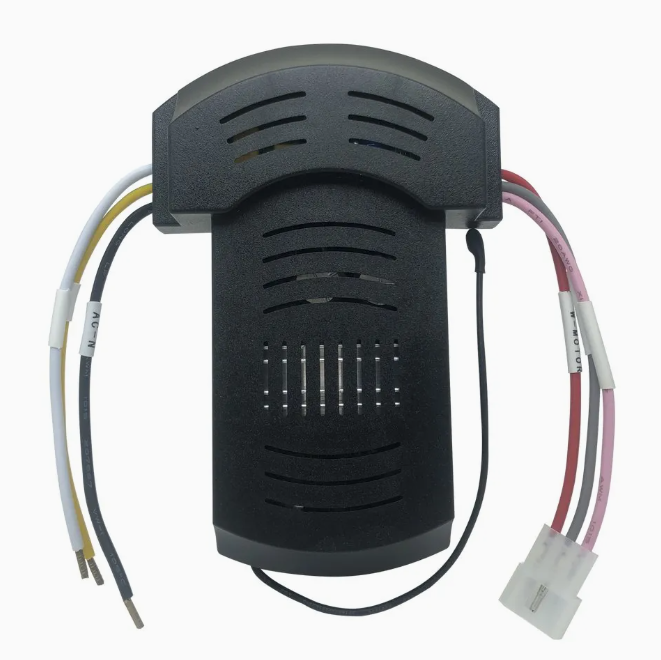
Custom Tuya Smart Ceiling Fan Light Remote
Custom Tuya Smart Ceiling Fan Light Remote. Review local controls, pairing, app functions and the matching receiver or motor board.
Built for your product platform.
Custom Tuya Smart Ceiling Fan Light Remote: recorded scope
Custom Tuya Smart Ceiling Fan Light Remote. Review local controls, pairing, app functions and the matching receiver or motor board. This page records what the listing currently states and separates it from what still has to be confirmed for your project. It is a working reference for an enquiry, not a released specification: the approved drawing revision, motor data and test plan take precedence over anything shown here.
What this listing records
| Listing title | Custom Tuya Smart Ceiling Fan Light Remote |
|---|---|
| Product category | Smart Controls |
| Internal reference | SK-140 |
| Signals named in title | Tuya |
| Configuration status | Not yet confirmed for a specific project |
Figures taken from a listing title are descriptive. They indicate the intended application; they do not establish the rated conditions of the unit supplied for your programme. Confirm them against the approved project configuration before quoting, sampling or designing around them.
Connected control and fallback behaviour
A Tuya-based control adds a connectivity layer on top of the fan or light control itself. The engineering brief should separate three things that are often conflated: what the unit does on the local interface, what it does through the app, and what it does when the router or cloud is unreachable. Each has its own acceptance criteria, and a prototype that demonstrates pairing does not by itself demonstrate stable daily operation.
- Commissioning path for the app and the account model it expects
- Behaviour on network loss, router restart and power restoration
- Whether local fallback keeps full function or a reduced set
- Firmware update route and how a failed update is recovered
What to confirm before sampling
These are the inputs the engineering team needs in order to turn this listing into a reviewable specification for smart controls.
- Local control behaviour when the network is unavailable
- Provisioning, firmware update and factory reset expectations
- App platform and any voice-assistant scope for the target market
- Data handling and privacy obligations in the destination market
Why this page does not quote full specifications
Publishing a numeric table that has not been traced to an approved drawing is worse than publishing none: a buyer can design a housing, a harness or a certification plan around a figure that was never verified. The parameters that decide whether this part fits your product – rated current under your load, thermal margin in your enclosure, connector pinout on your board revision, and the compliance scope for your market – are only meaningful once they are tied to a specific configuration.
What that means in practice is that the review is driven by your inputs rather than by a published table. Send the motor or load data, the available drawings and the target market, and the engineering team can respond with the specific values that apply to your build, together with the measurement conditions behind them. Where a figure cannot be supported for your configuration, the honest answer is to say so and propose the test that would establish it.
Application notes for this listing
Connected operation
A Tuya-based product is judged on what happens when the network misbehaves. Provisioning in a congested environment, recovery after a router restart and behaviour with the cloud unreachable are the scenarios that generate support load, so they belong in the specification.
- Provisioning success in a congested 2.4 GHz environment
- Behaviour when the cloud is unreachable
- Recovery path after a failed firmware update
Fan and light on one control
A combined fan and light control carries two loads with different characteristics. Light-control priority, the behaviour of one function while the other changes and the leakage limit with the light off are all part of the acceptance criteria.
- Priority between fan and light commands
- Leakage limit with the light switched off
- Smoothness of dimming at low levels, if dimming is in scope
Ceiling fan installation
A ceiling fan controller operates in a canopy above the blade set, which constrains both the space available and the radio environment for any remote function. Receiver placement and antenna orientation have to be evaluated with the canopy fitted.
- Space available inside the canopy
- Receiver placement and antenna keep-out
- Behaviour on a momentary power interruption
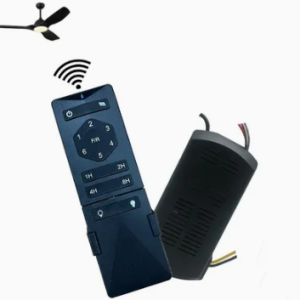
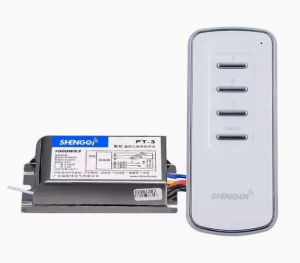
Handset and receiver as a pair
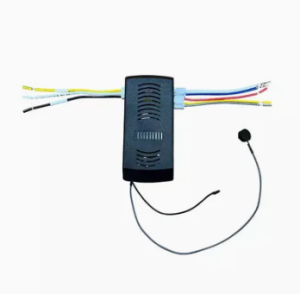
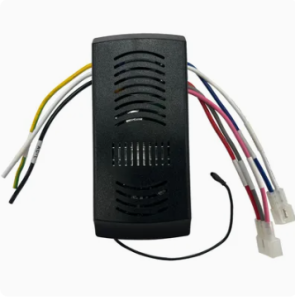
The handset is only half of the control system. The receiver or board it commands determines which functions can actually be invoked, so the pair has to be specified together rather than sourced separately.
- The receiver or board the handset must command
- Complete function list, including infrequent functions
- Button layout and legend before tooling
Connectivity has to survive a bad network
A connected control is judged by what happens when the network misbehaves, not by the demo. Provisioning on a hostile Wi-Fi environment, recovery after a router restart, and behaviour when the cloud service is unreachable are the scenarios that generate support load. They should be specified and tested before the product ships rather than patched afterwards.
- Define the fallback state and confirm it keeps the product usable
- Test provisioning against a congested 2.4 GHz environment
- Agree the recovery path after a failed firmware update
- Confirm the account and data model the app expects in each market
Where this type of part usually goes wrong
The most common failure is a connected product that works on the bench and fails in a real home. Provisioning succeeds in a quiet lab and times out in a congested apartment block; the app works until the router reboots and the unit does not rejoin. These are specification gaps rather than firmware bugs, and they are cheap to close if they are tested before tooling.
Test the connection, then test the product without it
A connected control needs two test plans rather than one. The first covers the connected behaviour: provisioning, command latency, state reporting and recovery. The second covers the product with the network deliberately removed, which is the state a meaningful fraction of customers will actually experience. Agree both before a pilot, and record the firmware build each result belongs to.
Keep the approved configuration, the app and firmware versions, the test network conditions and any open defects in one record. A change to the radio module, the antenna layout or the provisioning flow invalidates those results and should trigger a re-test rather than an assumption that the earlier evidence still holds.
Frequently asked questions.
Can this product be customized for our application?
Yes. Sankey can match the controller hardware, firmware, interfaces, protection functions, and production test plan to your motor and target market.
What information is needed for a project quotation?
Please share motor data, input voltage, rated power, required functions, target certifications, product drawings where available, and expected annual volume.
How is production quality validated?
Production support can include incoming inspection, AOI, ICT, functional testing, aging, and reliability checks appropriate to the confirmed project specification.